
Full thyroid panel
TSH, free T4, and free T3 together, so the request, the supply, and the active hormone are read as one system.
Accepting new patients.
Healing Advanced Solutions provides root-cause thyroid and Hashimoto's care in Jacksonville, FL, combining functional and integrative medicine: full thyroid panels read against functional ranges, reviewed by Catherine Seidle, APRN.
Real symptoms with a "normal" lab is the most common thyroid story in this office. It usually means one number was read instead of the whole chain.
The pituitary's signal asking the thyroid for more or less hormone. This is the only link a screening test reads.
The storage form the thyroid actually ships. Low supply with a quiet TSH is a real and findable pattern.
The body converts T4 into T3, the hormone your cells actually use. Conversion can falter on its own.
Reveals whether the immune system is attacking the gland, which is the most common root in the US.
Symptoms live at the end of that chain. Fatigue, weight gain, cold intolerance, dry skin, hair loss, and a slowed mood can all trace back to any link. That is why reading only the first one misses real problems, sometimes for years.
A TSH screen answers one question; the full panel answers the rest.
A TSH-only screen is a fair first pass, and when it catches the problem, good. The full panel exists for the people whose symptoms and screen disagree, and they are not rare.
In the US, most hypothyroidism is Hashimoto's, an autoimmune condition where the immune system attacks the thyroid. Hypothyroidism itself is common ground; the NIDDK counts nearly 5% of Americans ages 12 and older with it. Hashimoto's can smolder for years while TSH still reads normal, and it is diagnosed with antibody testing, not symptoms alone. Finding it changes the plan, because the target becomes the immune system's behavior over time, not just the hormone number on one lab.
One note on diet, since the internet is loud about it: nutrition genuinely matters in autoimmune thyroid disease, but no single "Hashimoto's diet" is proven. What we do instead is personalize, test, and watch your labs respond, without asking you to live on an elimination protocol that has no end date.
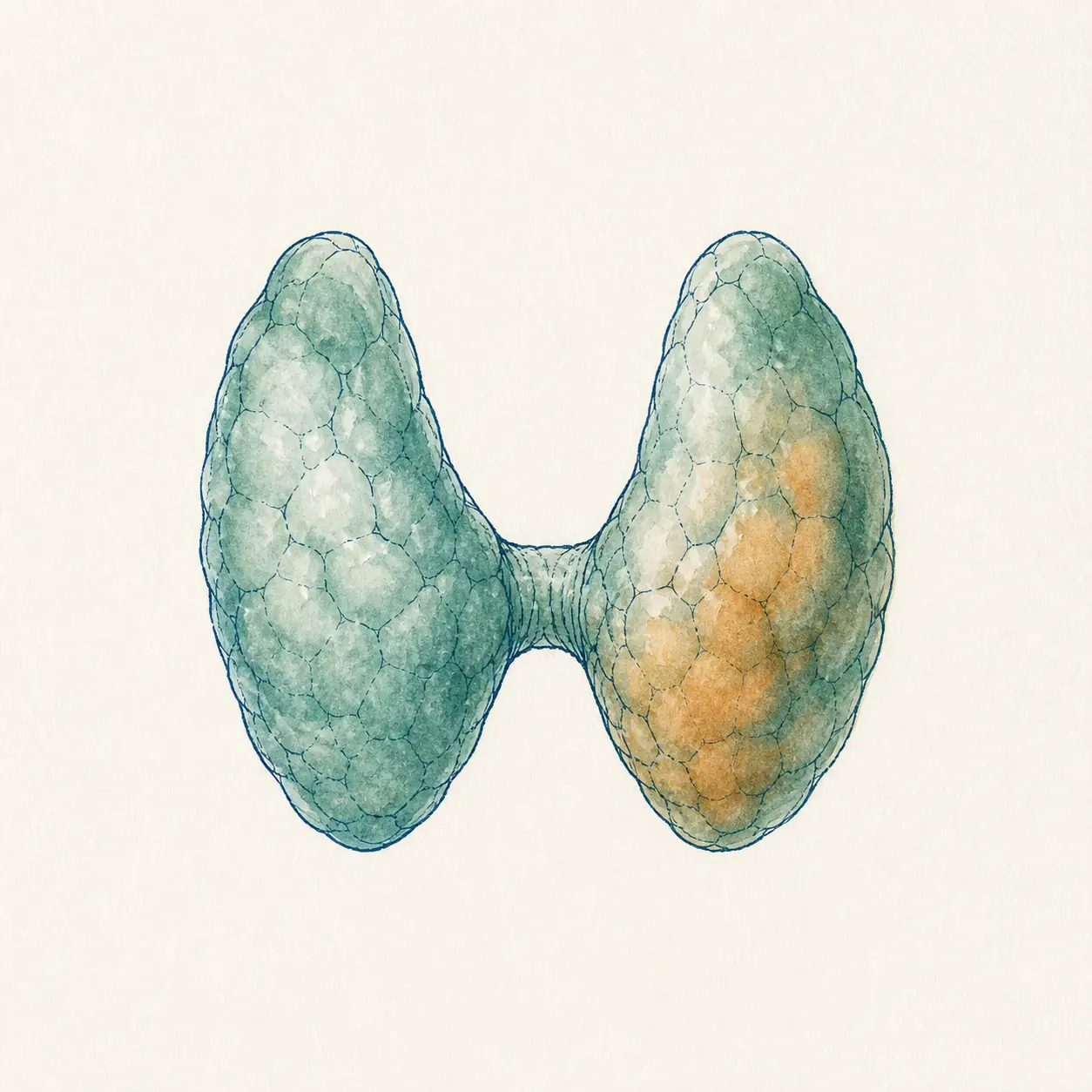
TSH, free T4, and free T3 together, so the request, the supply, and the active hormone are read as one system.
Thyroid peroxidase and thyroglobulin antibodies, the markers that find Hashimoto's instead of assuming it absent.
The nutrients thyroid function depends on, checked where your history points, because gaps here quietly drag the whole chain.
Where weight and energy overlap the picture, fasting glucose and insulin join the read.
The full panel is drawn in office and read against functional ranges as well as standard ones, the discipline our lab testing page describes. Nothing is ordered unless the result would change the plan.
Ten to fifteen minutes to decide together whether the full workup makes sense for your story.
Your history and the whole chain drawn in office: TSH, free T4, free T3, and antibodies.
Every marker explained against your symptoms, so you understand what is driving what.
Thyroid medication is prescribed and managed here when the labs call for it, with the root-cause plan built around it rather than instead of it.
Thyroid care is a long game measured in consistent labs and steady symptoms, not a two-week fix.
The things patients ask most.
It sets your metabolic pace. Thyroid hormone tells nearly every cell how fast to burn fuel. That is why an underactive thyroid can show up as fatigue, weight gain, cold intolerance, constipation, dry skin, hair loss, and a slowed mood all at once. Small gland, whole-body signal.
Because TSH alone is a thermostat reading, not the whole system. TSH can sit in the standard range while free T4, free T3, conversion, or thyroid antibodies tell a different story. A full panel read against functional ranges is how that gap gets found, and it is one of the most common stories in this office.
An autoimmune condition where your immune system attacks the thyroid, and the most common cause of hypothyroidism. It is diagnosed with antibody testing, not symptoms alone. Finding it matters because the target becomes the immune system's behavior over time, not just the hormone number on one lab.
It is manageable, and most people with it live entirely normal lives. It still deserves attention: untreated hypothyroidism strains the heart, metabolism, and mood, and the process tends to progress without attention. The practical answer is monitoring plus a plan, not fear.
Autoimmunity is the biggest driver in the US, with genetics, nutrient status, gut health, stress physiology, and environmental factors all contributing in ways that differ per person. That mix is exactly why a root-cause workup looks wider than the gland itself.
Most nodules are benign, and that determination comes from imaging and, when indicated, a biopsy. If you have a new lump, difficulty swallowing, voice changes, or a rapidly growing nodule, see a provider promptly for an ultrasound referral. We can help coordinate, but evaluation comes first.
This information is for general education and is not medical advice, a diagnosis, or a substitute for care from your provider. Lab results are reviewed with you by Catherine Seidle, APRN.
A free consultation, ten to fifteen minutes. Bring your last labs if you have them; we will walk you through what a closer look could add.
We reply within one business day.